Cascade Open Call RN1: GENESIS
Unraveling the Molecular and Immunologic Mechanisms of Intrahost Persistence in Emerging and Re-Emerging Arboviral Infections, the GENESIS study
Budget: € 2,514,962
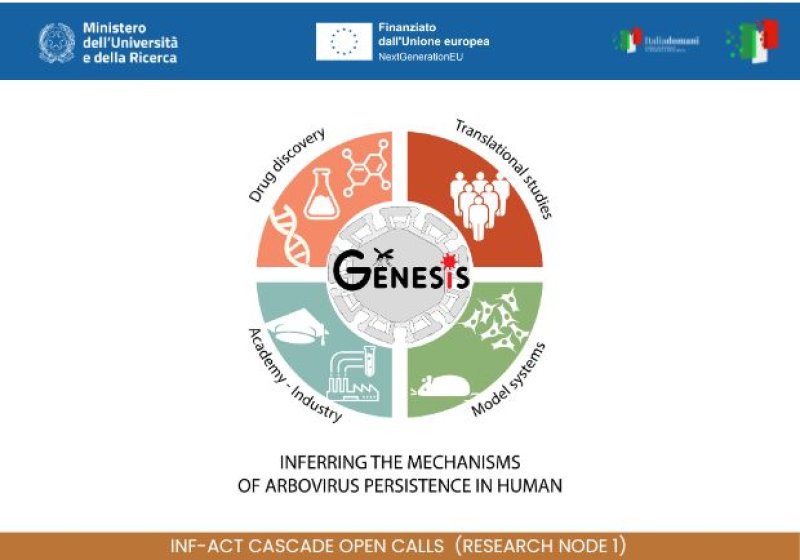
Arboviruses, including Chikungunya virus, Dengue virus (DENV), West Nile virus (WNV), Zika virus (ZIKV), and others, are a major global health problem, with their spread in Europe being exacerbated by climate change, spread of arthropod vectors, travel and trade. Their persistence in human and non-human hosts influences transmission dynamics, viral evolution, and public health. The mechanisms underlying the persistence and evolution of arboviruses in humans are poorly understood. To close this knowledge gap, ten public and private organizations have joined forces to carry out the GENESIS study. The consortium includes University of Pisa (coordinator), International Centre for Genetic Engineering and Biotechnology (Trieste), National Cancer Institute Fondazione Pascale (Naples), National Institute for Infectious Diseases Lazzaro Spallanzani (Rome), Fondazione TIGEM Telethon (Naples), University of Piemonte Orientale, and University of Trento. The private sector is represented by San Raffaele Hospital (Milan), DIESSE Diagnostica Senese SpA (Siena), and Scylla Biotech Srl (Messina). GENESIS aims to study DENV, WNV, ZIKV, and other arboviruses for their replication cycle, pathogenesis, and host persistence, and to evaluate selected host factors as potential drug targets. These goals will be achieved using in vitro and preclinical models. Additionally, GENESIS will study the antibody response elicited by the Toscana virus, an arbovirus endemic in Italy, in sequential patient samples to identify biomarkers of pathogenicity and persistence and refine current diagnostic assays.In line with the objectives of INF-ACT, GENESIS aims to better understand the virus-host interactions in these emerging viruses and to develop effective prevention, treatment and control strategies
Institutions involved